
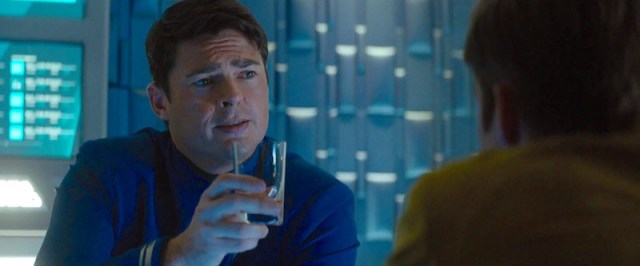
 Space, the final frontier…
I’ve been able to recite Captain Kirk’s monologue from the opening titles of the original Star Trek since I watched it in syndication more than 30 years ago. Today, my son – who is the same age I was then – can do the same with Picard’s variation while watching reruns of Star Trek: The Next Generation. Clearly, there is something about that epic speech “to seek out new life and new civilizations” which crosses generational boundaries. And while my wife and I did not take our son to see Star Trek Beyond in the theater this weekend, I think it will appeal to him when he is a bit older.
First off, Star Trek Beyond is by far the best Star Trek movie in 20 years. First Contact from 1996 was the last time that a Star Trek movie worked as a Trek story, a sci-fi/action movie, and a solid piece of film-making. The final two Next Generation films were weak, to be kind. The rebooted films by J.J. Abrams have been uneven and maddeningly averse to Star Trek ideas and ideals. The first made a decent attempt at refreshing the franchise, although its logical inconsistencies and bafflingly bad science take some of the fun out of it. The second film, Star Trek Into Darkness, had a great concept of breaking down the Federation to see the seedy underbelly and the dark warriors who preserve the peace regardless of the cost.
Then they threw in Benedict Cumberbatch as the iconic villain Khan. If there were logical inconsistencies and strange science in Star Trek (2009), they were nothing compared to what were given in Into Darkness. Add to that the fact that the movie tried too hard to be the fan favorite Star Trek II: The Wrath of Khan and that it ran for at least 30 minutes too long, and you had a recipe for a decent box office but a pretty terrible movie.
Given all that, I was concerned about the state of Trek in general and the quality of Beyond, specifically. Trailers and interviews built up my hopes, but I had been fooled by such things in the past.
“And I ripped my shirt. Again.”
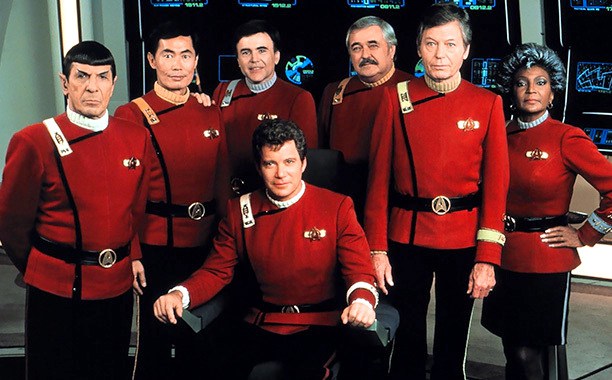
Anyone who knows classic Trek knows Captain Kirk’s shirt was always getting torn on away missions. That line from Kirk’s captain’s log less than five minutes in sealed my love for this movie. It was simultaneously funny yet respectful of the original series. The whole movie is like that.
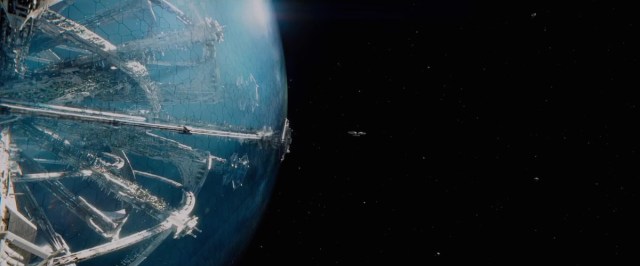
Funny. Thoughtful. Exciting. Tense. Action-packed.
Yet it never forgets that it is Star Trek.
A peaceful negotiation. A daring rescue mission. Strange new worlds. New life forms and new civilizations. Boldly going where no man has gone before.
Except, as the story reveals, the Federation has been to the planet on which the Enterprise crew find themselves stranded, the main crew paired off among themselves.
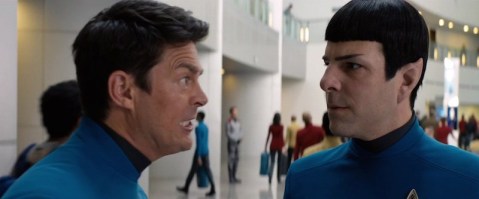
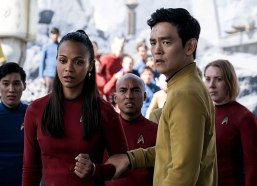 Sulu and Uhura are, sadly, the weakest pairing in the second act. Captured by the alien swarm that destroys the Enterprise in the first act, Sulu and Uhura have little to do but move the plot along. By contrast, Dr. McCoy and Mr. Spock are easily the best pairing. The cantankerous, curmudgeonly bickering between the two is spot on. They steal the show at every turn, and you can tell their antipathy belies a strong respect and affection for one another.
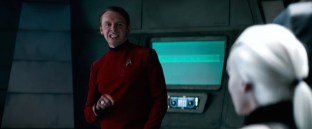 Scotty finds himself working alongside the alien survivor and all-around badass Jaylah, a welcome addition to the cast. The original crew always needed more strong female members. Jaylah is as smart as Scotty, as tough as Kirk, and entirely her own person. I loved that we saw a relationship develop between her and Scotty that had nothing to do with sexual attraction. Maybe they’ll hook up later, but their working friendship was good for now. Her acceptance to Starfleet Academy at the end of the film gives me hope we will see her again.
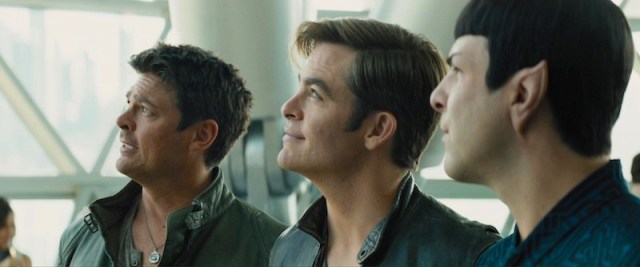
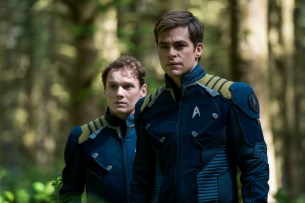 The big surprise match up, however, was Kirk and Chekov. I wasn’t keen on the new version of Kirk we got in 2009, although I didn’t hate him. He didn’t improve much in the most recent outing, either. It wasn’t actor Chris Pine’s fault. He did fine with what he was given. No one really found new Kirk’s voice until now. Finally, he’s the captain. Finally, I buy why people take orders from him. He’s not William Shatner’s James Kirk, but he’s easily the equal of that Kirk in this film. And while the late Anton Yelchin doesn’t get a lot to do, he’s just as exciting and personable here as he was in the previous two films. Knowing how tragically he died just weeks before this movie came out makes it that much harder to watch.
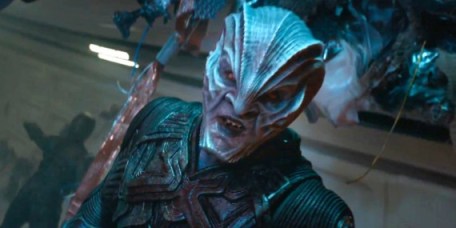 Trek is at its best when it’s about people working together to solve problems. Idris Elba’s villain Krall challenges the notion that we are better together. He threatens to tear apart everything the Federation has built in his far sector of space. He obviously hopes it will lead to a fracturing of the Federation, as tragic terrorist attacks often do to a nation. We are shown that the Federation is not infallible, that it does make mistakes such as giving former military officers command of peaceful starship missions or failing to save those lost to mysteries of space. We are also shown a Federation of officers who are willing to die to save people rather than living to kill people.
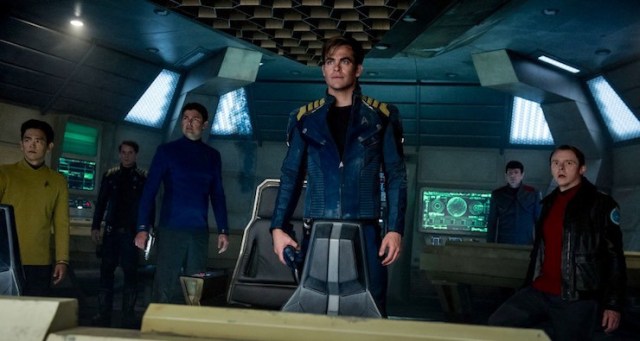
“I think you’re underestimating humanity,” Kirk tells Krall in their final confrontation.
“We will find hope in the impossible,” Spock reminds McCoy.
At a time when political rhetoric, police violence, war, irresponsible corporations, and all manner of hate threaten to tear humanity apart, Star Trek Beyond sends a very clear message that we can do better, and we can do it – we must do it – together.

 All of Time and Space