“Fear makes companions of us all.”
But does it truly make this episode faster, cleverer, and stronger than the rest?
Apologies for the lateness of this review. Life has a way of raising its ugly head from time to time. I’ll try to get the review for “Time Heist” up soon, too, so bear with me. Part of the delay has been the switch to WordPress, which is more robust than Blogger but also more complex in its set-up. Anyway…
Boy, was this a wild episode! We explored the past, present, and future of the Doctor, Clara, and Danny Pink this week. Many are calling it the best episode of Doctor Who since the show came back in 2005, and I’ll admit that it has its brilliant moments. The superb acting and characterizations of the three leads carry an episode that is very light on plot. So is the episode as good as everyone says? Well, let’s take a look. And listen!
Episode Summary
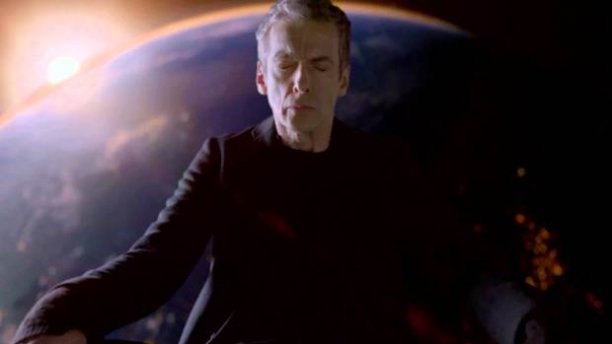 The Doctor spends an unknown amount of time traveling alone as he hypothesizes about natural evolutionary defenses. As he investigates the various lifeforms deemed “perfect” in their evolved methods of hunting and defense, the Doctor wonders about perfect hiders and if such a creature is why we talk to ourselves when we are alone. He ponders that we could not even detect or sense such a creature except when we inexplicably speak aloud when alone. Of course, he’s talking to himself while all alone at this point. A hand-written message on his new chalkboard – “Listen” – and the mysterious displacement of his chalk convinces him to seek out Clara’s input and assistance.
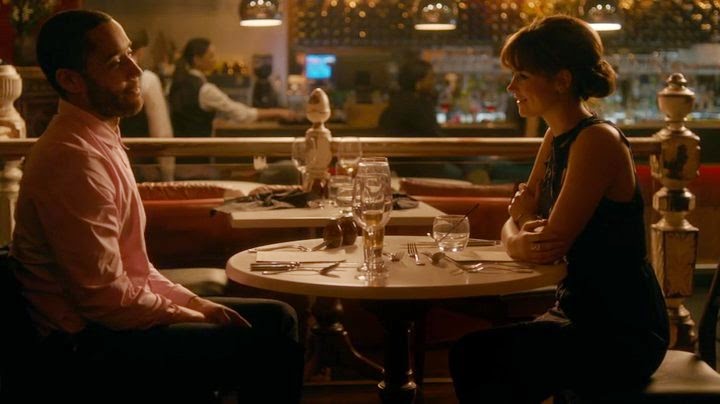 Unfortunately for both Clara and the Doctor, Clara just got home from her first date with Danny Pink, a total disaster of misunderstanding and miscommunication if ever there was one. The Doctor explains his ideas to Clara and points to the chalkboard as evidence. She asks him how long he’s been traveling alone, and he tells her that maybe he never has. He wants to track down the origin of a common dream of something hiding under the bed in the dark, something that reaches out and grabs the dreamer, and he wants to start with Clara’s own experiences. The Doctor releases the TARDIS navigation safeguards and telepathically plugs Clara into the system. He intends to take them back along her personal timeline, but she is distracted by a phone call from Danny which brings to mind memories of her date just as she interfaces with the TARDIS.
They arrive at the West Country Children’s Home in Gloucester in the mid-90’s. She says she’s never been to Gloucester, but the Doctor warns her to stay away from the building in case she runs into herself. As the Doctor runs off to investigate, Clara sees a boy in an upper window. He introduces himself as Rupert Pink (“a stupid name”), and Clara asks him if he’s awake because he’s scared. He nods in affirmation.
 Making his way down a creepy, dark, deserted hallway, the Doctor comes upon the night-watch caretaker and uses the psychic paper to convince the man that he’s on an official inspection. The man confesses that he often talks to himself. The Doctor also asks him if his coffee sometimes vanishes without a trace. When the man’s back is turned, the Doctor takes the coffee and wanders off to poke around some more.
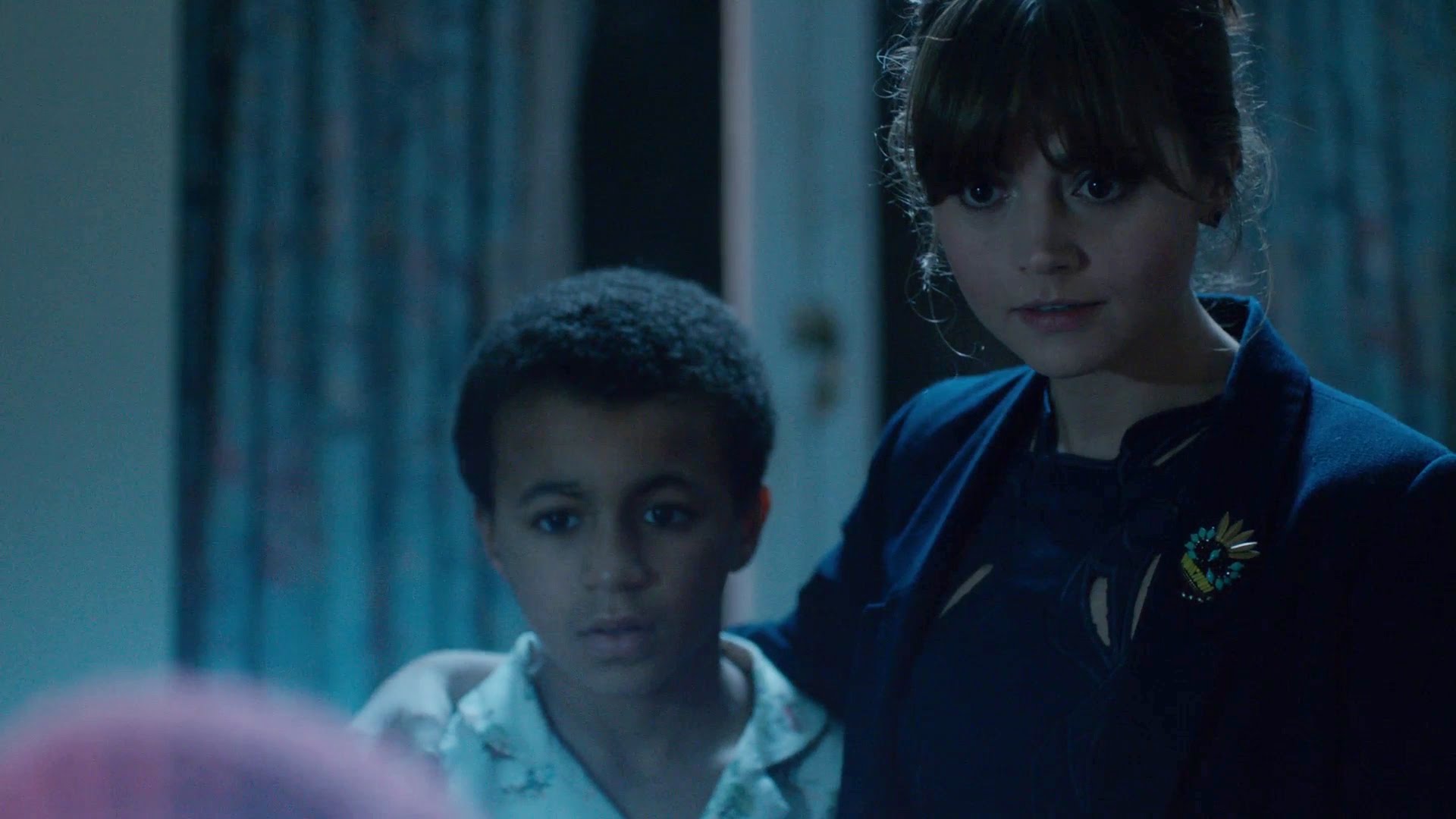 Clara arrives in Rupert’s room and chats with him about his fears and dreams. She looks under his bed for the monster he fears, pulling him underneath to prove there’s nothing there. Even as she comforts him, something makes a noise on top of the bed. He tells her that no one else is in the room and that nobody else came in while they were under the bed. They emerge to find a large lump in the middle of the bed. Clara asks if it’s one of the other kids playing a trick on Rupert, but the thing doesn’t respond. The Doctor shows up and asks if Rupert’s scared.
Rupert agrees that he is indeed scared. The Doctor says that’s a good thing and proceeds to describe the physiological and psychological benefits of fear. “Fear is a superpower. Fear is your superpower.” He tells Clara and Rupert to turn their backs on the thing. While they stare out the window, the Doctor speculates that the thing is either another child at the home or a monster of unbelievable horror. He orders the thing to leave and demands that Clara and Rupert not look and promise never to look. Then the thing is gone, taking the bedspread under which it had been hiding.
 Clara uses some toy soldiers to help Rupert overcome his fears. One of the soldiers has no gun because he’s so brave he doesn’t need a gun. Rupert names him “Dan the Soldier Man.” The Doctor puts Rupert to sleep and scrambles his memories to give him dreams of being Dan the Soldier man. After leaving Rupert to his dreams, Clara convinces the Doctor to take her back to her date with Danny, just after she previously stormed out. She reintroduces herself to Danny by way of apology, and he tries to do the same. Just as it starts to go well, she calls him Rupert and causes him to freak out. Again. This time he leaves.
Then a man in a spacesuit shows up in the restaurant to summon Clara back to the TARDIS.
 The space-suited individual turns out to be one Colonel Orson Pink, Earth’s first time traveler from about 100 years in Clara’s future, who looks exactly like Danny Pink (because he’s also played by Samuel Anderson). The Doctor found him by following Clara’s timeline and assumes he must be related to or connected to Clara somehow. He was on a planet at the end of the universe, which the Doctor was only able to reach (again) because the safeguards were off. Orson was supposed to go into next week and wound up at the end of time. The Doctor promises to take him home after the TARDIS recharges, but Orson doesn’t want to spend another night in his time ship. He’s terrified of something outside the hatch, and the Doctor wants to know what it is.
 The Doctor quotes an old nursery rhyme about the silence and the dark and death, and Clara asks him if they’re there because the nursery rhyme scared him as a child. Whatever it is tries to get in through the door, and the Doctor orders Clara to get into the TARDIS. The hatch opens and the ship begins depressurizing with the Doctor outside the TARDIS. Orson saves him, but he’s out cold. To escape the thing outside, Clara plugs back into the TARDIS and takes them to a seemingly-random location. When Clara exits the TARDIS to figure out where and when they are, she finds herself in a barn with a boy crying in his bed. She goes to investigate, thinking the boy must be Rupert or Orson, but she has to hide under the bed when she hears someone approaching.
A pair of adults enter, with a male voice criticizing the boy’s crying and saying that there’s no crying in the Army. The female voice says he’s out there because he doesn’t want the other boys to hear his crying and that the male voice knows why the boy cries at night. The woman encourages him to come sleep in the house, reminding him that he doesn’t have to be alone. As they leave, the couple discuss his prospects for the future, with the man saying that he’ll never make it in the Army if he runs away crying all the time. The woman reminds him that the boy doesn’t want to be in the Army, but the man says that the boy will never make it in the Academy and will never be a Time Lord. Clara realizes she’s under the bed of the First Doctor as a boy.
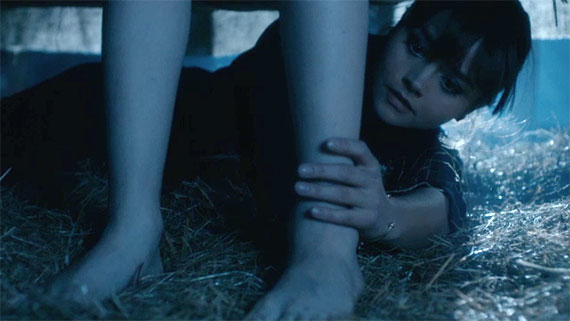 The boy gets out of bed when he hears the Doctor calling from the TARDIS for Clara. To stop the boy from meeting his future self, she reaches out from under the bed and grabs his ankle, the very nightmare the Doctor was investigating from the beginning. She encourages the idea that it’s just a dream an that he needs to go back to sleep. As the boy covers himself back up, she sits by his side and tells him to listen. She comforts the little boy and tells him that one day he’ll come back to the barn when he’s most afraid (as John Hurt’s brilliant War Doctor in “Day of the Doctor”). She also gives him the “fear is a superpower” speech and leaves Orson’s Dan the Soldier Man with the prepubescent Doctor. When she returns to the TARDIS, she orders the Doctor to take off and never look at where they’ve been.
They return Orson to his home, and then the Doctor returns Clara to her home, where she reunites with Danny once more. They share a kiss and admit that they’ve been afraid and react poorly to fear.
The Not-So-Good
This episode is very light on plot. There’s not a lot to the story, and what is there doesn’t really flow all that well. We get the scenes with Clara, Rupert, and the Doctor at the orphanage in the first half. Then we get the rather jarring shift to the Doctor and Clara with Orson at the end of the universe. This really feels like two separate episodes that were crammed together to make one. With a little room to breathe and to build the tension, this could have made a brilliant two-part episode, which we haven’t seen in a while. We could have perhaps seen some of the fallout on the time line from Clara’s interaction with young Rupert. We could have built up the mystery of whatever it was on the bed or at the end of the universe.
Also? Haven’t we already been to the end of the universe back in series 3 with the Tenth Doctor in “Utopia”? There’s just a lot of little elements to the plot that could have used some refinement to make it all hang together a little more coherently.
The Brilliant and Fantastic
Steven Moffat is genius of characterization and relationships. The episodes he writes usually contain some of the best moments of character development for companions and the Doctor alike. Guest and supporting characters also fare well under Moffat’s pen. He made a name for himself with the series “Coupling,” a British comedy series that is often compared to “Friends,” except actually good and funny with much more likable characters. So Moffat’s script here, despite not delivering a very strong plot, gives us the best of his character-based writing.
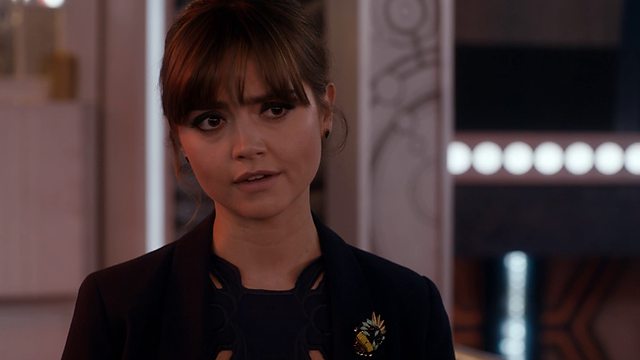 We get Clara being strong in the face of some rather creepy and dangerous situations. Yet she’s still clumsy and vulnerable in her personal life, making bad jokes and overreacting quite a bit during her date with Danny. She’s not defined by her relationship with him, but she does want it to work because h’s obviously a very nice man. Jenna gives what is probably her best performance to date throughout this episode, and the scenes with Danny highlight just how good she is with awkward-relationship comedy. If Jenna Coleman truly is leaving at the Christmas special, as has been speculated, I hope she finds some roles in good romantic comedies. She plays it well.
She also handles the Doctor well in this episode, questioning him and standing up to him on several occasions. This culminates at the end when she orders him to leave and not look back. She manages to be just as commanding and mysterious to the Doctor as he often is with her, yet she does it with a warmth and compassion that the Twelfth Doctor really has yet to demonstrate.
 Speaking of the Twelfth Doctor, Peter Capaldi goes all-out in this one. His portrayal of the Doctor’s obsessive research into the unknown “Hiders” is intense to the point of irrationality, which is a great take on it. The Doctor is a naturally curious individual, but Moffat and Capaldi take the Doctor’s inquisitiveness to a new level here. The Doctor cannot let go of this idea that there is something out there, something that causes people to dream the dream of something under the bed, something that causes people to talk to themselves when alone. When Clara asks him how long he’s been traveling alone, we truly believe that he’s gone just a little mad from it. The rebooted series has tried to show us at various times the effect of traveling alone on the Doctor, but this is the first time I’ve truly felt that he’s gone off the deep end because of it. He’s not violent or angry because he’s been alone for a while, but he’s so focused that he can’t see anything else. He doesn’t even know who Clara was with on her date.
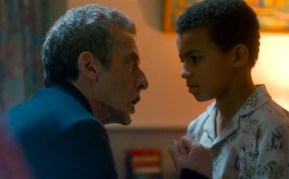 At the same time, however, he’s still surprisingly touching. He gives Rupert the big “fear is your superpower” speech to comfort the scared little boy. Yet you can’t help wondering if he’s also saying it to convince himself that nothing’s wrong with being afraid, if he’s trying to bolster his own courage. Capaldi gives us an intense, frightened, frightening, caring, curious Doctor. He is all that we have loved about the Doctor for fifty-one years boiled down to the essentials, and I love it. I hope that he chooses to stick around for a lot longer than his predecessors did, because Capaldi’s Doctor has the capacity for character growth and development that we have not seen since the Sixth and Seventh Doctors and the so-called Cartmel Masterplan of the late-80s. I hope the rest of the writing this season can keep up with Capaldi’s acting.
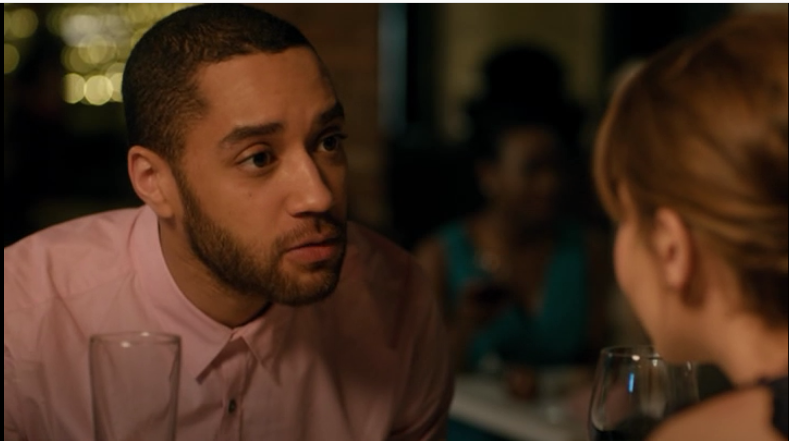 But the heart of this episode, for me, was Samuel Anderson in the dual roles of Danny and Orson Pink aided by child-actor Remi Gooding as the young Rupert “Danny” Pink. Danny has been a brilliantly complex character from his introduction, but we’ve only gotten the tiniest glimpses of who he is as a person. I think the slow-reveal of him has been a fantastic strategy, as it leaves me wanting more of the character. The biggest reason I’ve wanted more is that Samuel Anderson is just so damn captivating as Danny. He’s equally compelling as Orson in this episode. And somehow, he’s transferred his charm, charisma, and vulnerability to Remi Gooding, because that kid nails his younger version of Danny perfectly here. Both actors are on top of their game as the Pinks, bringing Danny’s pain and fear Orson’s terror and longing to life with deft, subtle touches in what could have been incredibly over-wrought scenes full of histrionics.
The ending, where Clara encounters the younger version of the Doctor, ties everything together thematically. Danny’s fears as a boy led him to take up the mantle of a soldier who fought in wars but also dug wells to help ailing villages. The Doctor’s fears as a boy led him to run through time and space seeking out the weak and innocent to travel with him and to protect from harm, yet he had to make some very tough choices that led to many deaths. The comparisons and contrasts between the two characters highlights why Clara is drawn to both. Ultimately, both men are caring, compassionate souls who need a friend to help them keep their fears at bay.


 All of Time and Space
-Haven’t we already been to the end of the universe back in series 3 with the Tenth Doctor in “Utopia”?
…not exactly. It was near enough to the end to count for their purposes, but what was more significant was that it was the last planet to have any humanoid life on it in the universe. It’s implied that this is an even further point in time since there’s no humans (or human descendants) left at all.
Also, thank you for not calling him Twelve. That makes me want to punch people. (And truthfully, I don’t see any purpose in calling him anything other than “The Doctor” unless there’s a reason to refer to a specific incarnation, like if we’re talking about a particular era or comparing incarnations. I mean, the point of it all is that even though he’s a bit different from regeneration to regeneration, he’s still the same person.)
-Yet you can’t help wondering if he’s also saying it to convince himself that nothing’s wrong with being afraid, if he’s trying to bolster his own courage.
Of course he is. The end of the episode really confirms that, I think, if not basically the entire rebooted series history. 😛
On a related note, I hate calling it a reboot…it’s most emphatically NOT a reboot. Revival would be a better word but it’s kind of awkward.
On an unrelated note, Coupling was so vastly superior to Friends it’s not even ever worth debating with anyone. Friends was just unfunny, full stop.
LikeLike